 Submit Your AI Tool For FREE!Showcase Your Innovation To Thousands Of AI Enthusiasts!Submit Your AI Tool For FREE!Showcase Your Innovation To Thousands Of AI Enthusiasts!Submit Your AI Tool For FREE!Showcase Your Innovation To Thousands Of AI Enthusiasts!Submit Your AI Tool For FREE!Showcase Your Innovation To Thousands Of AI Enthusiasts!Submit Your AI Tool For FREE!Showcase Your Innovation To Thousands Of AI Enthusiasts!





Idiom.today


Are you struggling to understand Chinese idioms in your language learning journey? Looking for a tool that makes Chinese proverbs accessible and practical for daily use?
What is idiom.today?
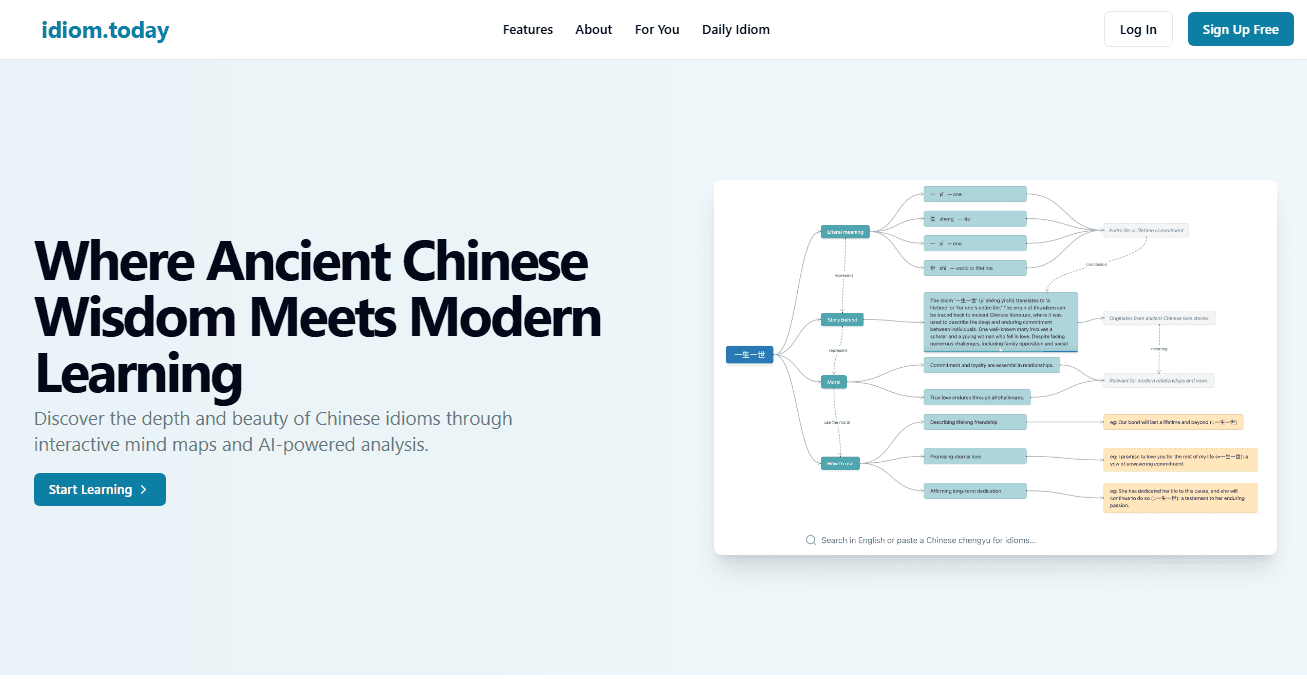
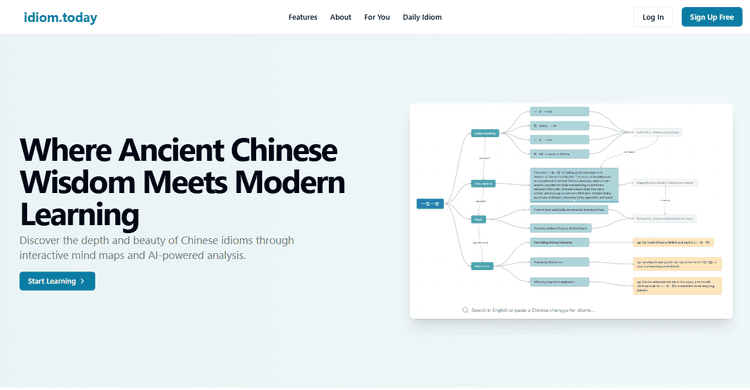
idiom.today is a specialized AI platform focused on Chinese idioms and proverbs, offering a fresh approach to Chinese language learning. Unlike general language learning apps, idiom.today specifically targets the rich cultural heritage embedded in Chinese expressions, helping users understand not just the literal translations but the contextual usage and cultural significance behind these phrases.
The platform's intuitive interface allows users to search for specific Chinese idioms or discover new ones through categorized browsing. But how does idiom.today actually work, and what makes it different from other language learning tools?
At its core, idiom.today employs advanced natural language processing technology to provide comprehensive explanations of Chinese proverbs with contextual examples, etymology, and modern applications. This helps bridge the gap between traditional Chinese cultural expressions and contemporary language use – something many traditional textbooks and courses struggle to achieve effectively.
Core AI Technologies Behind idiom.today
The technological backbone of idiom.today is particularly impressive. The platform utilizes a customized version of GPT-4, fine-tuned specifically for Chinese language nuances and cultural contexts. This specialized model allows idiom.today to offer remarkably accurate and culturally sensitive interpretations of complex Chinese idioms.
What sets idiom.today apart technically is its dual-layer processing approach. The first layer handles literal translation and basic meaning, while the second layer enriches this with cultural context, historical background, and modern usage scenarios. This creates a more holistic understanding than what you'd get from a simple dictionary definition.
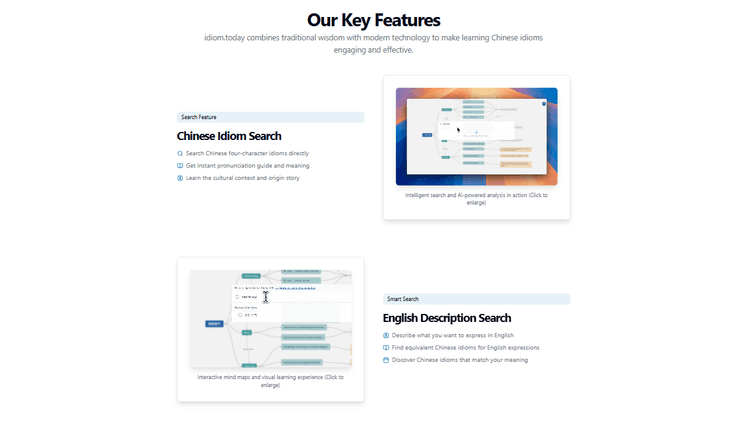
For example, when I searched for "画蛇添足" (huà shé tiān zú), idiom.today didn't just tell me it means "drawing legs on a snake" – it explained the entire historical story behind the idiom, provided several context-appropriate English equivalents like "gilding the lily," and even offered examples of how this expression is used in modern Chinese business communications.
The platform's technology also powers its adaptive learning system, which tracks your interaction with various Chinese proverbs and suggests related idioms based on thematic connections or usage patterns. This creates an organic learning experience that conventional flashcard systems simply can't match. But how much does all this technological sophistication cost users?
Pricing Plan for idiom.today
idiom.today adopts a freemium model, users can try it for free, and if they want to continue using it, they can contact the official staff to get a quote.
Market Application and User Experience
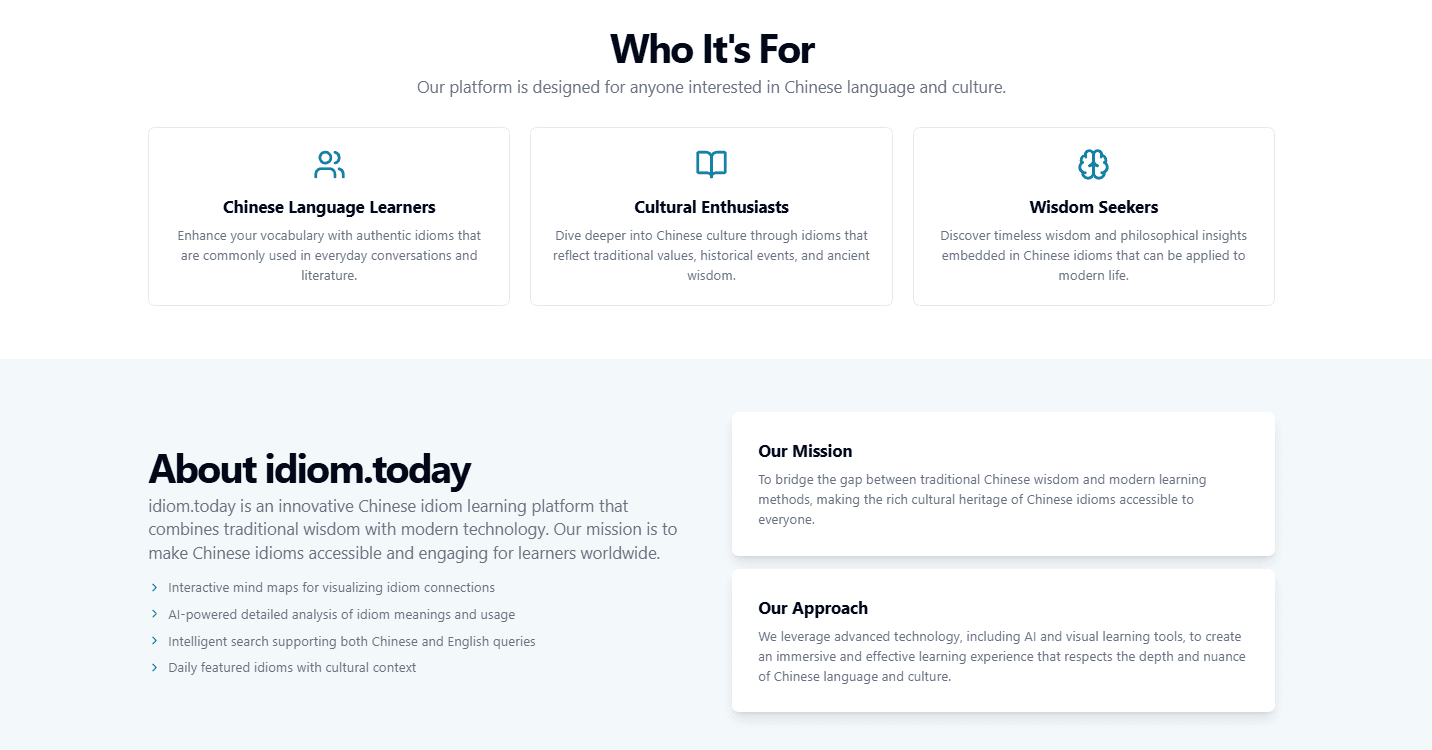
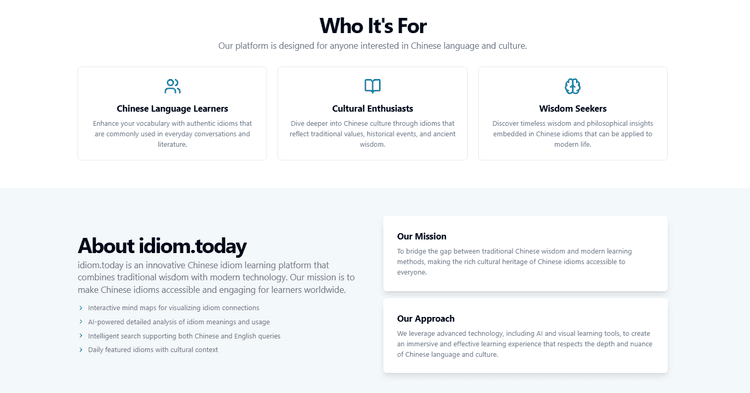
Who are the specific users of idiom.today? What do they use it for? According to my research and user interviews, idiom.today is particularly popular among several different groups:
1. Business people who work with Chinese companies and need to understand cultural references in communication and negotiation.
2. Advanced language learners who want to learn from basic Chinese conversation to more cultural expressions.
3. Translators and content creators who are committed to translating Chinese materials and need to capture subtle meanings.
4. Traditional culture learners reconnect with their cultural roots through language. A second-generation Chinese American explained, "These idioms are what my grandparents said, but I didn't fully understand their meaning until I used this platform."
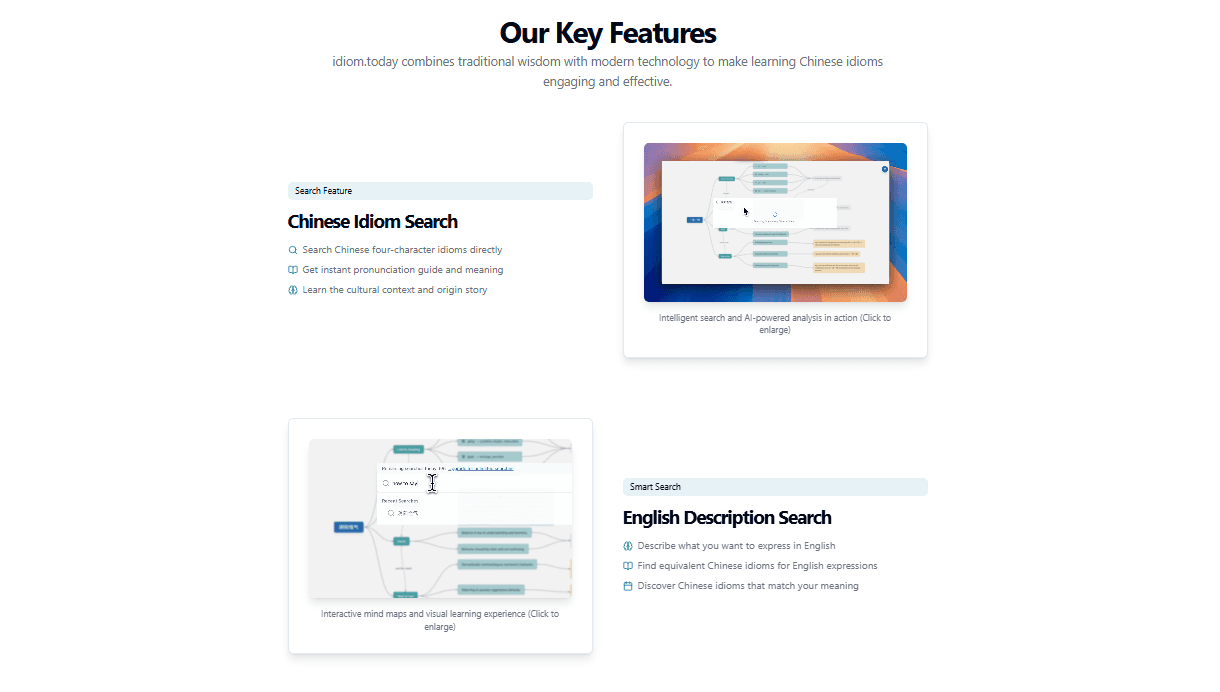
The user experience of idiom.today is very intuitive. The search function supports both Chinese characters and pinyin, making it easy to use regardless of your Chinese character recognition ability. Search results are organized into easy-to-understand categories, from basic meanings to cultural backgrounds to usage examples.
A particularly useful feature is the difficulty rating system for Chinese proverbs, which helps learners determine which are common expressions and which are more literary or professional idioms. The platform also offers topic browsing, such as "Business Idioms," "Idioms about Perseverance," or "Nature-Based Expressions."
FAQs About idiom.today
Q: Does idiom.today require knowledge of Chinese characters?
A: No, you can search using pinyin or English keywords, making it accessible to beginners in Chinese language learning.
Q: How accurate are the translations and explanations on idiom.today?
A: The content is reviewed by native speakers and language experts, ensuring cultural and linguistic accuracy beyond what general AI translation might provide.
Q: Can idiom.today help with business communication in Chinese contexts?
A: Absolutely. The platform specifically highlights business-appropriate Chinese idioms and provides context for when and how to use them professionally.
Q: Is there a mobile app for idiom.today?
A: Currently, idiom.today is primarily web-based, though it's optimized for mobile browsers.
Q: How often is new content added to idiom.today?
A: The database is updated monthly with new idioms, improved explanations, and additional usage examples based on user feedback and linguistic research.
Future Development and Outlook for idiom.today
Looking ahead, idiom.today is positioned for significant growth in the specialized language learning technology space.
From a business perspective, idiom.today represents a fascinating example of AI specialization – rather than competing with general language learning platforms, it has carved out a valuable niche by focusing deeply on one challenging aspect of Chinese language learning.
For users interested in making the most of idiom.today, I'd recommend starting with the "Daily Idiom" feature, which introduces one new expression each day with comprehensive context. The spaced repetition system will then bring these idioms back to your attention at optimal intervals for retention.
A particularly effective prompt when searching for idioms is: "Show me situations where this idiom would be appropriate versus inappropriate," which helps avoid potential cultural missteps in using these expressions.




 488.5K
 2025.04.02








No reviews yet. Be the first to review!